
 Add to Teams
Why it pays to be curious


Curiosity never killed a cat. Unless it’s licking a live plug socket obviously, but that’s more Darwin Award territory… Anyway, Meeting Canary is growing at pace. We tipped over 1,000 regular users this week, and have many thousands of meetings under our belt. So what that gives us is a means for being very, very curious.
We have been challenged a few times about how we ‘cost in’. We get the ‘well it’s lovely that you give us all this data but if I have to pay for it how can I know that I’ll save time and money?’
My answer from a year ago would be: ‘Well it’s hard to imagine how you cannot save money if you finally unlock the quantitative side of what you are doing in all those thousands of meetings’.
That’s true of course – you cannot manage what you do not measure, but it’s also an expression of: ‘Well you’ll have to wait and see and when we have enough data we’ll have a much better answer for you’.
Well now we have. There are literally dozens of different metrics that Meeting Canary collects and if you act upon the evidence, you can reduce meeting time and reduce meeting attendance – both considerable savings in their own right.
But for the sake of brevity lets focus on one KPI:
Lateness
I truly cannot abide lateness. I’m reliably informed this is an age thing, I’m Gen X (the coolest of all the bands, I can tell you), and Gen X and their much, much older friends the Boomers are always early. Always. But in meetings, way too many people are late. How often do you hear: ‘Let’s give it a few more minutes whilst we wait for the others to join’.
‘NOOO’ I shout (often silently in my head, but not always) ‘let’s crack on’.
So why does this matter? Well look at this graph below. I’ve taken around 20 meetings and looked at the time that the last participant arrives and its relationship to how much small talk occurred in the meeting. Small talk is not a bad thing – it’s the human condition to want to ask people about traffic, weather and if their new cat is still alive. But the theory we had was that late arrival means more small talk.
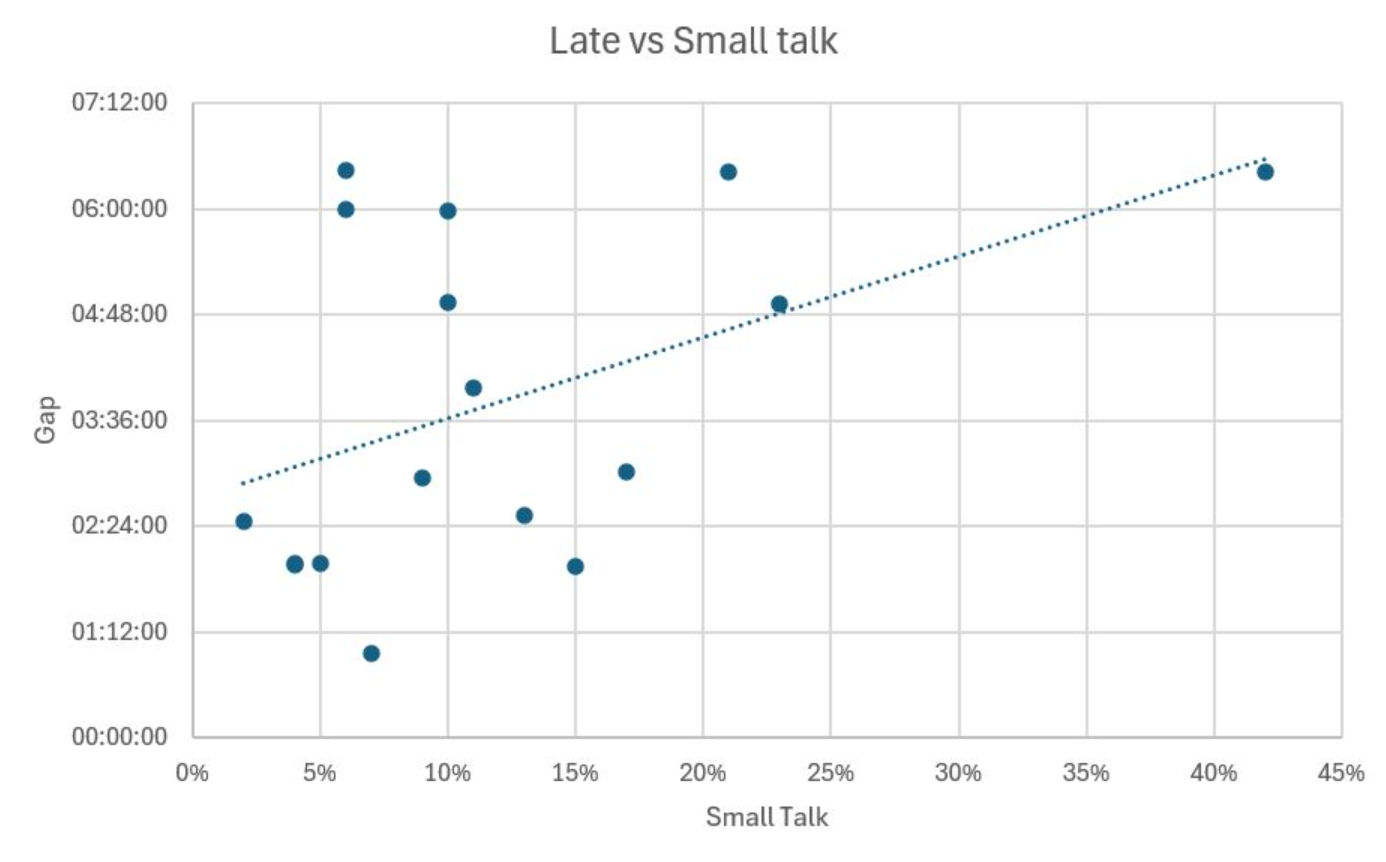
Well look at that, small talk goes up as people arrive late!
But why does that matter? Well in this sample, the average amount of small talk as a percentage of the meeting time was 8.3%. In the US alone, research indicates that as much as $400bn is wasted in unnecessary meetings each year. Therefore, armed with this actual evidence, and giving yourself the data to encourage people to turn up on time it’s perhaps reasonable to aim for say 5% small talk? Saving 3.3% of your meeting time?
Now, in a probably quite statistically insane leap of faith, let’s show that 3.3%, if applied to that $400B number above. That gives us a nice fat $13,200,000,000 or if you want to conceptualise that rather large number, according to the IMF that is just a bit short of the GDP of the Bahamas.
This is why curiosity never kills cats, it just gives them more cream.